CRO Guide 2026: How to Turn Visitors into Quote Requests

The exact process we apply to increase conversion rates on service websites: audit, page hierarchy, social proof, the form, and testing. With concrete benchmarks and real project examples.
We have optimised dozens of service websites in Romania: construction companies, dental clinics, real estate agencies, car repair shops. The conclusion is always the same: most websites do not have a traffic problem, they have a conversion problem. They increase the Ads budget, traffic goes up, enquiries stay the same.
Below is the exact process we apply, step by step, with the concrete benchmarks we follow and the order in which things are worth doing.
1. Measure first: without a baseline, every “optimisation” is guesswork
In the first week we change nothing. We install measurement and establish reality:
- Current conversion rate = enquiries / sessions. For service websites, the average is 1-2%. A good site reaches 4-6%. Below 1% means a structural problem, not a copy problem.
- Separate events for every action: form submission, phone click, WhatsApp click. If you only track the form, you lose 40-60% of real conversions — people call.
- Session recordings (heatmap + replay) on at least 200 sessions. This is where the truth shows: people do not scroll, do not read text blocks, and click images that are not links.
- Traffic source by conversion – Ads traffic converts differently from organic. A single aggregated number lies to you.
Only after this data do we decide what to attack. Without it, a “redesign” means painting the car before checking whether the engine starts.
2. Hero: the 5 seconds that decide everything
Session recordings always show the same pattern: the visitor decides within 3-5 seconds whether to stay. In those seconds the page must answer three questions, with no scrolling:
- What do you do? – the headline states the service and the outcome, not a slogan. “Websites that bring quote requests, not just visits” beats any “innovative digital solutions”.
- For whom? – if you do plumbing in Cluj, say “Cluj”. Specific converts, generic does not.
- What do I do next? – one primary CTA, visible without scrolling, with a verb: “Request a quote”, “Book a consultation”. A “Learn more” button that just leads to the services page is a dead conversion.
Our rule: one screen = one action. Two competing buttons in the hero cut your conversion rate by 20-30%.
3. Social proof, placed where people actually decide
The classic mistake: all testimonials crammed into a section at the bottom that 70% of visitors never see.
We distribute proof exactly at the friction points:
- Next to the first CTA – 2-3 short reviews with name, company, and a concrete result (“they grew our enquiries by 40% in 3 months” beats “very professional”).
- Next to the form – this is where fear peaks: “what happens with my data?”. One short line (“We reply within 24 hours, no spam”) plus a review raises completions by 10-15%.
- Portfolio with context, not a gallery – every project with one sentence about the problem and the result. Pretty pictures impress, numbers convince.
Watch authenticity: reviews without names, or names like “Andrew M.” with no company, look fabricated and backfire.
4. The form: where most conversions die
The form is the end of the funnel and the place where 50-80% of possible enquiries are lost. What we always apply:
- Maximum 4-5 fields for the first enquiry. Every extra field cuts completion by ~10%. “Budget” and “message” can be optional; a phone number is enough to start the conversation.
- Pre-selected country prefix on the phone field – it looks like a detail, but it reduces abandonment on mobile, where 60-70% of traffic lives anyway.
- Human-readable errors: “Enter a valid phone number” inside the field, not a red toast at the top of the page.
- Visible confirmation after submission + a message about what happens next (“We call you within 24 hours”). Missing confirmation creates duplicate enquiries and distrust.
- A visible contact alternative: phone and WhatsApp next to the form. Some people simply do not fill in forms.
5. Mobile: where the game is played
For our clients, 60-75% of traffic comes from mobile, and the mobile conversion rate is usually half the desktop one. Not because mobile does not convert, but because the site was designed on a monitor.
Our mobile checklist:
- A sticky action button at the bottom (WhatsApp / Request a quote), reachable from anywhere on the page.
- Clickable phone number everywhere it appears (tel: link) – it sounds trivial, yet we still find numbers displayed as plain text.
- The form fits on one screen, fields use the right keyboard (numeric for phone).
- LCP under 2.5s on 4G – speed is conversion too: every extra second of load time costs 7-10% of conversions.
- No full-screen popups on entry. If you want exit-intent, on mobile you trigger it on scroll-back, not on a mouse movement that does not exist.
6. Test, but with discipline
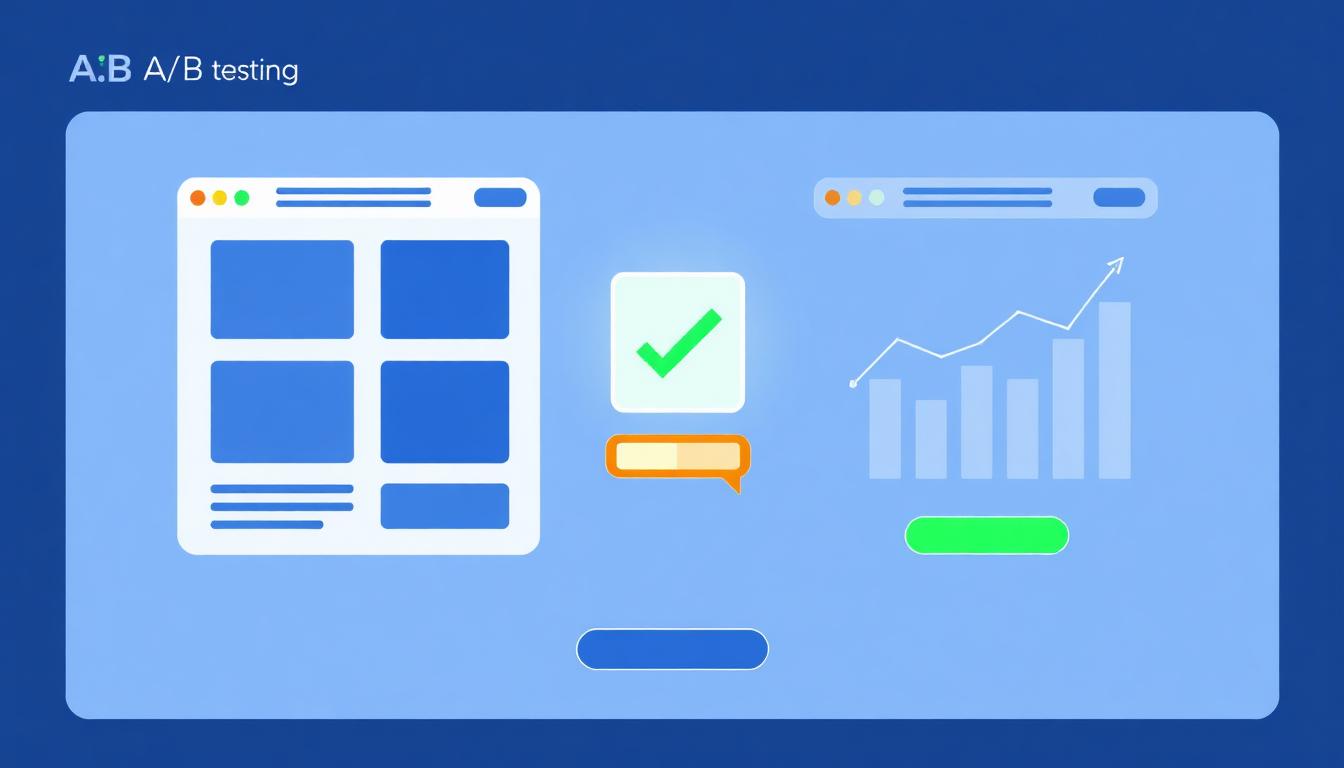
A/B testing is the last stage, not the first. There is no point testing the shade of orange on the button when the form has 9 fields.
The right order:
- Fix what is obviously broken (sections 2-5 above).
- Then test big hypotheses: a different value proposition in the hero, a different section order, an offer with a starting price vs. no price.
- One test = one change, for at least 2-4 weeks or ~300 cumulative conversions, otherwise the result is noise.
- Document everything: what you tested, the period, the outcome. A team that forgets what it tested 6 months ago tests the same things forever.
Conclusion
CRO is not magic and not a list of tricks. It is a process: measure correctly, fix friction in order of impact, distribute proof where people hesitate, and only then test. For most service websites, the first 4 weeks of conversion work are worth more than doubling the ad budget.
If you want to see exactly where you are losing enquiries right now, request a free audit – we will show you on real recordings where visitors leave and what we would change, in order.
Want a website that brings in customers?
We'll give you a clear proposal, with price and delivery time, no obligations.
Request a Quote